
Author: twentytwo
We are delighted to have been instructed by Stonewood Homes to market Arms Gardens, beautifully designed and carefully constructed family homes in the sought-after North Wiltshire village of Sutton Benger.
Designed to inspire, this exclusive development will comprise just eight individual detached stone built properties offering a choice of 3, 4 or 5 bedrooms. Enjoy traditional design with contemporary finishes. Generous living spaces, high spec kitchens and bathrooms – the attention to detail is second to none.
Perched between the Cotswolds and North Wiltshire, Sutton Benger is a quintessentially English village, boasting a church, a pub and a popular primary school. Just 5 miles north of Chippenham, the development is conveniently located for swift access to Bath, Swindon and Cirencester.
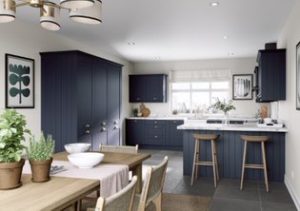
Kitchen

Living room

Bedroom
Caroline Ferris, Associate Partner at Perry Bishop and Chambers managing valuations and sales in North Wilthshire, is now registering interest in this bespoke development.
Email Caroline now to register your interest:
northwiltshire@perrybishop.co.uk
Author: twentytwo
Estate agents have witnesses a surge of interest in moving to the country as city dwellers’ priorities changed during the coronavirus lockdown. A desire for more space, a garden and a study for homeworking have fuelled this flight from our cities. In June and July Rightmove reported an eye-watering 126% jump in enquiries about buying a home in a village location compared with the same period last year.
Nup End Green, a small development of individually designed new homes in the beautiful village of Ashleworth being marketed by Perry Bishop and Chambers’ Cheltenham branch, is proving very appealing to those seeking their own slice of the ‘Good Life’. Only two of the thirty-five homes remain – both 5 bedroom detached properties, built to a very high spec throughout and offering contemporary open-plan living, perfect for family life.
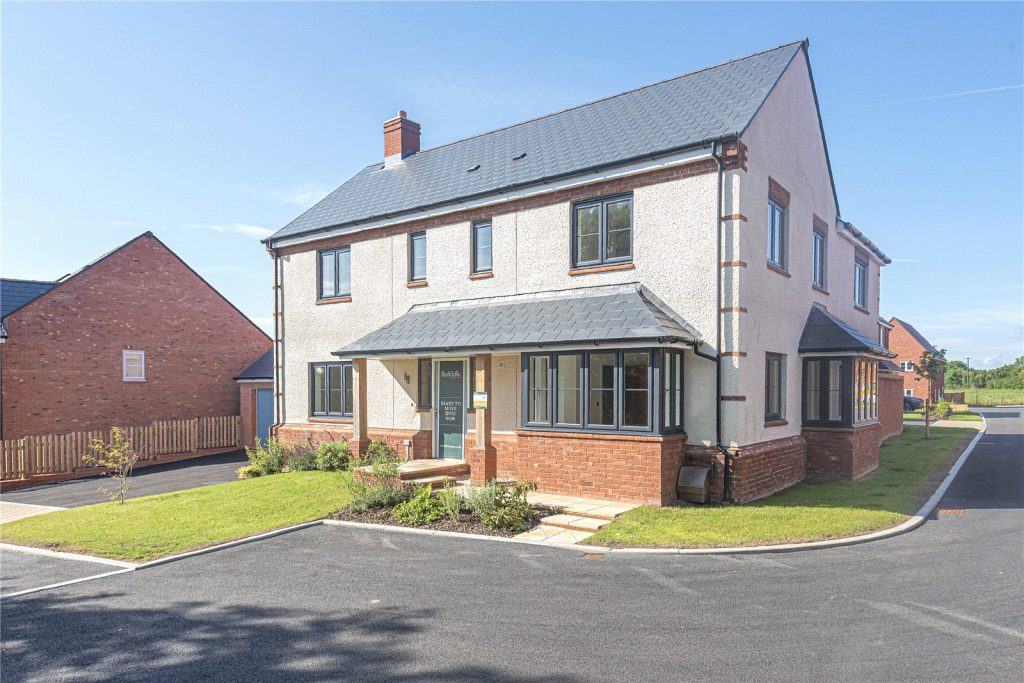
The Ashbury, Nup End Green, Ashleworth
The village has a distinctive and charming character, the oldest part being Ashleworth Quay, situated on the west bank of the River Severn. A relaxed and friendly community, this quintessential English village with its local post office, village shop, church, pub and excellent village primary school, ticks all the boxes. Whether your interests are sporting, cultural or leisurely dog walking, the area offers them all in abundance.
If you’re looking for the best of both worlds – village life with swift and easy access to the hubbub of Gloucester and Cheltenham – Nup End Green is the perfect next move.
Call Perry Bishop and Cheltenham on 01242 246980 to arrange your viewing.
Author: twentytwo
We are delighted to welcome our newest recruit, Marc Blackford, who joins us as Land Development and Commercial Manager. He will be based in our Cirencester office, but will be managing opportunities across Gloucestershire, Oxfordshire and Wiltshire. For the last 15 years Marc has worked as National Sales Director for a leading commercial agent and brings with him a wealth of experience working within the licensed/leisure/hospitality/sports and commercial property industry. He is also Associated RICS qualified.
Marc lives in Cheltenham with his wife and three daughters. He coaches two local football teams, one of which his youngest daughter plays for, and he is also a big fan of horseracing – in fact, he runs a racing syndicate and owns half a racehorse!
“Marc’s expertise in both commercial and land sales will complement our current land and new homes offering. As the Government seeks to relax and speed up the planning process and with the recent easing of change of use for commercial property, Marc’s experience will prove invaluable for developers across our region,” said Phillip Bishop, Managing Director at Perry Bishop and Chambers.
If you are looking to buy or sell land or invest in or dispose of commercial premises, please call Marc on 01285 646770 or email marcblackford@perrybishop.co.uk
Author: twentytwo
As we head for late summer Phillip Bishop of Perry Bishop and Chambers assesses the property market.
Covid19 hasn’t been the only outbreak this year. There has also been an outbreak of property sales and letting since the end of national lockdown. The press has called this current property market a mini boom. We call it a maxi boom.
Mini booms occur when there is above average activity. Maxi booms happen when for some properties buyers are queueing up, in many cases there are multiple offers for most properties on the market, and deals regularly go to best and final offers only to exceed the original guide prices. This is often what we are currently experiencing.
Nor has the lettings sector been left out of this market frenzy. There is enormous demand for rental properties.
Since the general lockdown ended our phones have been practically ringing off the hook and the numbers of visitors to our website and social media pages have skyrocketed.
Many things have changed since the pandemic hit our lives. One of these changes is in the attitude many of us have to how and where we live. A demand for more spacious and environmentally healthy living is driving the market, spurred on by a temporary reduction in stamp duty that has not only helped many second and third step buyers, but also has galvanised holiday home and buy-to-let purchasers.
Another change this summer is the government’s vowed intent to simplify and speed up the planning process. The current system has been described as “complex and slow” by the housing minister. It is a view hard to argue against.
But shouldn’t the minister also be looking at the current snail-pace of the conveyancing process? This is causing completion delays of up to six months in some parts of the country. How can buyers and sellers plan properly with this much uncertainty? It is a lamentable situation in this digital age, and one worthy of any government’s urgent attention.
As we head into late summer amidst all these changes our phones are still ringing and the email inbox bursting there is no let up in demand. We don’t know how long this surge in demand for property will last, but for buyers and sellers right now it is a boom market. So our advice is; to change your room use this boom.
Author: twentytwo
There was a surge in demand for buy-to-let property in July, according to the latest data released by mortgage technology provider, Twenty7Tec.
With significantly more tenants seeking homes to rent, buy-to-let properties are currently in high demand.
Affordability is a major factor forcing many people to rent with house price to earnings ratio increasing sharply over the past couple of decades,
Lifestyle choices and changes are another major factor as to why renting is now preferable to buying for some people.
Phil Bailey, group sales director, Twenty7Tec, said: “To say that July has been strong for BTL is an understatement. We only dipped below 10,000 BTL ESIS documents on one day all month – July the 1st.
“Prior to July, we had not been above 10,000 documents per day at any stage. The search volumes may lag slightly behind earlier in the year, but when it comes to ESIS documents, we are well ahead of any time prior YTD.”
However, despite growth in demand from BTL landlords since lockdown restrictions were eased, there has been a notable dip in search levels for BTL mortgages over the past week or so.
Bailey added: “Most days in July were among the busiest this year for BTL searches. At the end of July, however, the 7-day rolling average dropped back to beginning of the month levels.”
James Tucker, CEO of Twenty7Tec, believes that it will be interesting to watch what happens with the BTL drop off over the next few days.
He said: “Was it a blip after the PM’s tightening of [the lockdown] rules nationwide or a pre-cursor to what we can expect in the coming months?”
article courtesy of LandlordToday
Author: twentytwo
New guidance on face coverings for agents working in branches, and for those dealing directly with visitors, was issued at the end of last week.
A statement from NAEA Propertymark – the industry body for estate and lettings agents dedicated to promoting the highest industry standards – said:
Over the last two weeks, Propertymark has been seeking clarification on whether the Government’s requirement for customers to wear face coverings when entering shops in England, extends to branches of estate and lettings agents. We are aware that in the absence of updated guidance, there has been widespread speculation from industry commentators.
While agents offer professional services akin to solicitors and accountants, many offices are based in high street locations and are currently benefiting from a business rate discount designed for retail businesses.
Having worked towards clarity with Ministry for Housing, Communities and Local Government on this, Propertymark is now in a position to update members.
In line with Propertymark best practice guidance, estate and lettings agents should only be welcoming visitors on an appointment basis and when all other methods of communication have been exhausted. It is not necessary for agency staff to wear a face covering while sharing an office with the same group of people and social distancing. However, when dealing with any type of visitor, any member of staff in proximity should wear a face covering. Visitors to the office should also be asked in advance to wear a face covering.
A protective desk shield can be used in place of a face mask as long as it covers the area sufficiently and is being cleaned regularly.
Propertymark continues to promote the importance of both clients and agents wearing personal protective equipment on every visit to a residential property.
Author: twentytwo
Propertymark is the latest industry body to warn the government against Capital Gains Tax changes that may disincentivise landlords.
A joint statement from the ARLA and NAEA wings of the association says: “The government need to tread with care with the review into the capital gains tax system and all consequences, whether expected or unexpected, need to be considered.
“If the review includes allowances too, which would be sensible, then as with the recent stamp duty changes, taking people out of the tax equation should be an aim too.
“Increasing rates further for investment properties could reduce appetite from landlords who provide vital housing to the private rented sector, which will have a detrimental impact on supply.”
There is growing concern in the sector that the current review could add to the tax attacks made on landlords in recent years.
Chancellor Rishi Sunak has requested a review of CGT rules from the Office for Tax Simplification.
The OTS has published an online survey and a “call for evidence” to seek views regarding CGT, with the consultation closing on October 20.
This would mean new CGT rules, taking into consideration the consultation, could be presented at the autumn Budget expected in November.
According to the Treasury the consultation aims to “hear directly from individuals and businesses” as well as “professional advisers and representative bodies” about which aspects of capital gains tax are “particularly complex and hard to get right, and to hear any suggestions for improvements”.
CGT is currently charged at 28 per cent on the sale of second homes and buy-to-let properties, and in 2017-18 300,000 people paid the tax, generating almost £60 billion.
article courtesy of Letting Agent Today
Author: twentytwo
Report hailed by housing minister and leading design organisations reveals surprising things people will soon want – and not want – from new-build homes.
A survey backed by the government and organised by one of the UK’s most prestigious design organisations has revealed what Britons will want from their homes in ten years’ time – and cookie-cutter design is definitely off the menu.
The research reveals that 76% of those interviewed said they wanted a home that’s attractive and with its own identity. But it also reveals significant numbers who believe their future home should be greener, better designed and easier to maintain. More specifically, they also want more space to grow vegetables, be able to move between renting and owning more easily and be able to extend or adapt their homes with greater ease.
Called Home of 2030, the report is an attempt to force house builders to construct homes that fit people’s needs better, and that nearly of those quizzed said their current home will not be ‘fit for purpose’ by the end of the decade.
Conducted among 2,039 people, housing minister Chris Pincher says the report is one of the largest-ever exercises “to place people at the heart new homes”.
“I’m keen to see the Home of 2030 entries later this year and how they take these principles on board to deliver new low-carbon homes and independent living for older generations. Green, clean homes will help our economy to bounce back more sustainably than ever before,” he says.
FOOD FOR THOUGHT
But it’s also food for thought for those who design homes and is part of a competition being run by the Design Council, RIBA, BRE and the Ministry of Building Innovation to jump-start new ideas within the wider property industry.
This new insight will inform the second stage of the Home of 2030 competition later this year – during which shortlisted designers, developers, SMEs, contractors, funders and product suppliers will come together to develop their concepts in Phase 2 of the competition.
Article courtesy of Nigel Lewis, The Negotiator
Perry Bishop and Chambers New Homes department is currently marketing a number of bespoke new homes from award-winning developers. For inspiration, take a look at Peltrace House in Cirencester, Lewiston Mill on the edge of Stroud, Whitelands in Tetbury and – coming soon – a select development in Sutton Benger in North Wiltshire.
Author: twentytwo
With post lockdown demand for property at a welcome high level, one thing was needed to help create what could be the most active market since the great recession: greater affordability.
Now the Chancellor has gone a long way to help through his mini-budget. From 8th July 2020 until 31st March 2021 there will be a temporary stamp duty holiday on the first £500,000 of all property sales in England and Northern Ireland. This does not affect Scotland and Wales, which have their own property transaction tax regimes.
Under Sunak’s change buyers of second homes and buy-to-let properties will also benefit, but will still have to pay the existing 3% extra duty due on the entire price.
During this tax holiday, the average stamp duty bill will fall by £4,500, and almost nine out of ten people buying a main home this year will pay no stamp duty at all. Anyone buying a home for around £475,000 will save almost £14,000 in tax and all purchases above £500,000 will save £15,000.
In the property industry we have long called for the government to overhaul a tax that has become a serious hindrance to buyers. Although seen as unfair by many, the government’s annual return from stamp duty is around £12bn – roughly equivalent to 2% of the Treasury’s total tax income. However even the Prime Minister has said in the past that he wanted to scrap stamp duty up to £500,000 and reduce the top rate – on homes costing more than £1.5 million – from 12% to 7%.
With the Halifax announcing, unsurprisingly, that house prices have fallen during the four months of lockdown, the new stamp duty level and the increased desire by many to make a lifestyle change mean this is the best time for years to buy and sell a property.
As any farmer will tell you, make hay while the sun shines.
Author: twentytwo
There has been much said in the press recently about leasehold property, particularly on the issue of escalating ground rents and developers selling houses on a leasehold rather than a freehold basis.
So much so that the government instructed the Law Commission to undertake a review on leasehold enfranchisement. Their report on ‘options to reduce the price payable’ was published on 9 January 2020 and we await further information from the government on how they intend to implement the findings.
The inescapable fact is that a lease on a property is a diminishing asset which slowly loses its relative value over the length of the lease. All leaseholders should know that, subject to owning a property for a minimum of 2 years, they have a statutory right to extend their lease by an additional 90 years and there is an accepted way of calculating the cost of this lease extension.
The cost of any lease extension rises exponentially through the length of the lease, so it is best to act early. A group of leaseholders can also come together to acquire the Freehold of their building.
A helpful website for anyone with an interest in a leasehold property may be found at the Leasehold Advisory Service which offers free advice to leaseholders and freeholders alike.
Ian Perry FRICS – co-founder of Perry Bishop and Chambers – has over 40 years experience in advising both leaseholders and freeholders in these enfranchisement cases and is able to offer advice on taking the statutory route or extending a lease on an informal basis.
Contact Ian to discuss any of your leasehold concerns:
ian@irperry.co.uk
t. 01242 231754
m. 07774 726665