
Category: Sales
We feel the time has come for us to put the safety of our colleagues, clients and customers first. We have taken the difficult step of closing our offices to visitors with immediate effect unless by prior appointment. Most of our staff will be working from home for the foreseeable future, but the Company remains very much ‘Open for Business’.
Over the next few days our phones will divert to mobiles and we can still be contacted by e-mail. We will be carrying out Market Appraisals by video and we are producing viewing videos of our properties which can be e-mailed to you or viewed on our social media channels.
We thank you for your understanding and send you and your family our best wishes at this difficult time. Stay safe, stay well and keep social distancing.
Category: Sales
Last week Phillip Bishop was interviewed by Tim Thurston for community radio station Swindon 105.5.
Selling or buying a property is a complex process and as a nation, because we are moving home less often, when we do decide to take the plunge few of us are up to speed on all that’s involved.
Phillip provides a helpful reminder of the key things to bear in mind when making what for most of us is our biggest purchase. Great advice hear for anyone who hasn’t moved in a while as well as those buying their first ever property.
Click here to listen now.
If you are looking to upsize, downsize or buy your first ever property take a look at what’s on the market with Perry Bishop and Chambers, one of the region’s leading independent estate agents with branches serving Gloucestershire, Oxfordshire and Wiltshire.
Category: Sales
If you are buying a home in England costing more than £125,000, you will have to pay Stamp Duty Land Tax on the purchase of your new home. In the provinces, it’s called something slightly different, so if you are buying a property in Scotland over £145,000 you will pay Land and Buildings Transaction Tax (LBTT) and for any property over £180,000 in Wales you will pay Land Transaction Tax (LTT). Whatever the tax is called, it is an important factor when moving, when you consider that
Last year the average UK house buyer paid £10,150 in Stamp Duty Tax alone
Now as soon as the date for Rishi Sunak’s budget was set for 11th March 2020, conjecture in the Press began about what stamp duty changes he may disclose on budget day. The Chancellor only sets the budget for England and Northern Ireland, yet this is just as relevant for Wales and Scotland. Even though Derek Mackay, the Scottish Finance Secretary said on 6th February he has no plans to change Scotland’s version of Stamp Duty (LBTT), more often than not, Stamp Duty rule changes in England are often adopted in Wales and Scotland at a future date.
Some are asking if Sunak will impose what was promised in the Conservative manifesto with the 3% additional Stamp Duty surcharge on non-UK resident buyers? I have certainly heard in the Estate Agent community that foreign buyers are trying to rush through their sales in central prime London (Park Lane/Mayfair etc etc) before 11th March to ensure they don’t get hit with a new tax. Or will he go even further, and will we see a reappearance of Boris Johnson’s hitherto specified aim of eliminating Stamp Duty below £500k, consequently theoretically saving homebuyers many thousands of pounds?
However, opinions are divided on what, if anything, will be included in the budget. Most believe that the extra 3% for foreign nationals is an almost certainty, and if it isn’t implemented straight away, it will be in the Autumn Statement. Many believe the Chancellor could also decide to repay the favour to those in the North who turned the Election map ‘blue’ on the evening of 12th December with actions to enhance the housing market north of the M62 with stamp duty changes. The best way he could do that is to raise the threshold from the current £125k.
When Boris ran for Tory leadership back in May 2019, he said that he wanted to expand the threshold at which you begin paying stamp duty from £125k to £500k, which when you consider 7 out of 8 residential sales in 2019 were for homes below £500k, that would have a considerable effect. If the Stamp Duty threshold had been raised to £500k in 2019, then 700,400 homebuyers in England would not have paid any Stamp Duty Tax.
84.3% of Faringdon properties sold last year were below £500k
Of the 248 properties sold in the last 12 months within a 3-mile radius of Faringdon, only 39 of those properties sold were over £500,000 (interesting when compared with Greater London where 44.9% of properties were below the £500k level).
Yet the cost to the HM Treasury would be significant. If all properties below £500k were exempt, the government would lose £2.22bn in tax receipts according to Savills. Of course, this could be made up with extra tax on empty properties or increasing the second homes Stamp Duty levy from the current 3% to say 5%, which would raise an additional £1.12bn on top of the current £1.68bn it raises for the Treasury, yet it would have a negative effect on buy-to-let landlords buying additional homes.
What almost unquestionably won’t happen is the earlier idea of switching the Stamp Duty liability from homebuyer to home seller
This would stall the property market, would probably cause political fallout among 688,300 homebuyers who paid Stamp Duty last year alone, make homes ‘appear’ more expensive as house sellers would inflate the asking price to try and recoup some of the tax, yet ultimately could be seen as ‘re-arranging the deckchairs on the Titanic’.
The 3% additional levy for foreign buyers is almost certain (of which we don’t get many in Faringdon – as they tend to buy in prime London areas which is of course the City of Westminster and the Royal Borough of Kensington & Chelsea, and parts of the boroughs of Hammersmith and Fulham, and Camden), yet I have a feeling that ultimately the Government doesn’t want to rock the boat on the wave that is being rode by the property market on the ‘Boris Bounce’ since December. I also doubt any changes will be made to first time buyer Stamp Duty relief, as 22% of all property transactions in 2019 were to first-time buyers, and whilst it cost the Treasury (or saved the first-timer buyers) a total of £539m in Stamp Duty relief (an average of £2,411 each), the Government are keen for first time buyers to get onto the housing ladder.
Ultimately, we can only wait until Mr Sunak opens his red leather box on tomorrow to find out what will happen. I will of course report back after the budget on what (if any) changes to the tax regime will affect the Faringdon property market going forward.
Category: Sales
MD Phillip Bishop looks ahead to the March Budget. The year has started well in the property market, but what could the Chancellor do to really get things moving?
On the 11th March, Budget Day, all eyes will be on our new Chancellor of the Exchequer, the Rt Hon Rishi Sunak MP.
One group of English taxpayers will be especially interested in what, if any, changes there are to Stamp Duty. This tax is payable by those buying property over £125,000 – although first-time buyers aren’t liable for stamp duty on homes up to £300,000. The taxation for Scottish and Welsh homebuyers is slightly different.
With the average house price in the UK now £234,742, this stamp duty affects a great many homebuyers. So much so, that over the 2018/19 tax period, the government collected almost £12 billion in stamp duty revenue. A cynic might think, small wonder the government is actively persuading the population to buy homes.
But the problem with high stamp duty is that it does the opposite. It deters people from moving – prevents people in larger homes, they don’t need, from downsizing and selling to people who do need them. It stalls the market and prevents a natural flow of discretionary buying and selling.
A previous Tory plan was to overhaul stamp duty by raising the threshold from £125,000 to £500,000 and lower the top rate – which applies above £1.5m – from 12% to 7%. But this was dropped from the last election manifesto. Could the Chancellor resuscitate this policy? It would greatly help the housing market if he did.
Although the introduction of a mansion tax is looking unlikely, overseas buyers will worry that the Chancellor will introduce a 3% stamp duty surcharge. This tax would include ex-pats wanting to move back home – after Brexit, more likely than for many years. This levy would be on top of stamp duty already payable, including the 3% surcharge on second homes and buy-to-let properties.
Successive chancellors might not have been precisely helpful to the housing market. Now that this government seems keen to build infrastructure, perhaps they will be inclined to treat housing – and flood defences – with the same importance the population does. Railway lines may be necessary but aren’t good homes and a buoyant property market more so?
Category: Sales
The door is now open to easier development opportunities.
Recent changes to Permitted Development rights mean that converting agricultural buildings into residential properties is now far simpler than ever before. Now rural landowners no longer need to apply for planning permission to convert barns to residential, school or nursery (childcare) use.
In summary, the order creates a new class of permitted development ‘Class MB’, which allows change of use from agriculture to residential use.
Prior to the announced changes a barn could be converted to provide up to 3 new homes within a maximum of 450 square metres, the new changes allow:
up to 3 larger homes within a maximum of 465 square metres
or
up to 5 smaller homes each no larger than 100 square metres
or
a mix of both, within a total of no more than 5 homes, of which no more than 3 may be larger home.
For further clarification on this new ruling please contact the region’s leading land and development service on 01285 646770 to discuss your options and learn how you can realise the true value of your agricultural buildings.
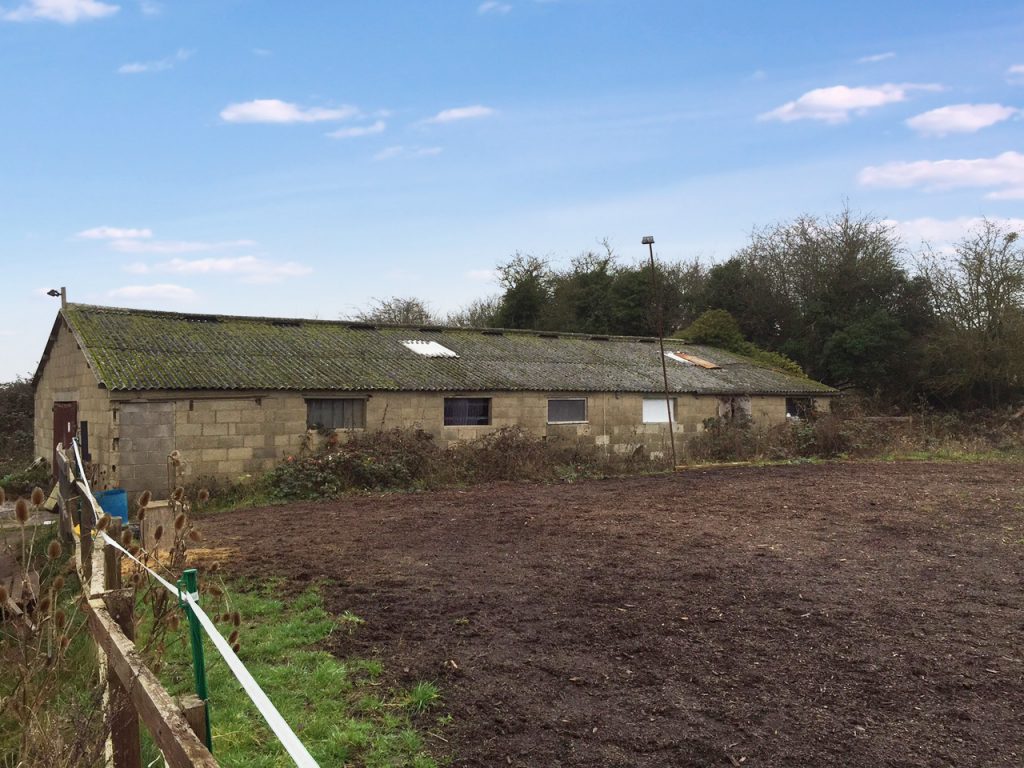
Example of redundant barn sold by our Land and Development team
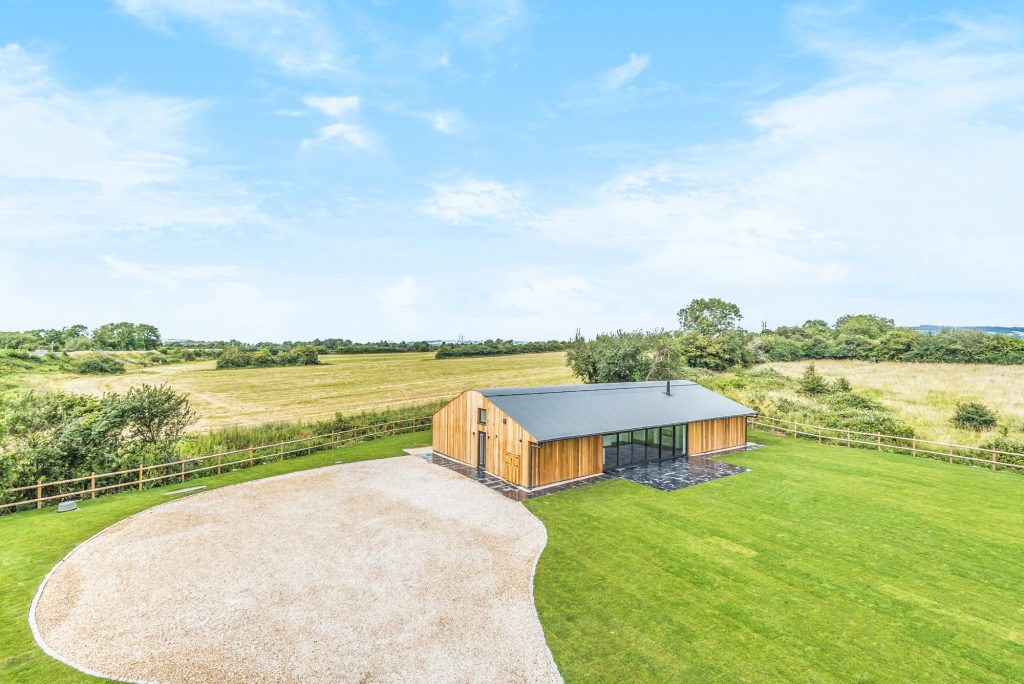
Barn now converted to sell by our Cheltenham branch
Category: Sales
Join us at Cowley Manor, Cheltenham, on Wednesday 4th March for our timely seminar – Buy to let and Property Development in 2020. Expert speakers from Crowe Clark Whitehill, BPE solicitors and The Finance Roome will be joining members of Perry Bishop and Chambers lettings and land teams to consider the current state of the industry and review changes afoot.
This free of charge event is essential for all landlords and property investors – providing the very latest info on financing and tax arrangements, lettings legals and new trends within the sector.
We have limited spaces, so please RSVP as soon as possible to reserve your spot.
Date: 4th March 2020
Time: 3.30pm – registration with teas and coffees
4.00pm – seminar starts
5.00pm – drinks and patisserie
Venue: Cowley Manor, GL53 9NL
RSVP: michelleenglish@perrybishop.co.uk
We look forward to seeing you there!

Category: Sales
Ah the 2010’s, the tens, the teens – I am not sure what we are supposed to call the decade that has just gone. No matter what it was called, the last decade was a tough one, so does it really matter that we never really got around to giving it a name? Some might say, whatever one calls it, coming to an end is the most fundamental job any teen (and I refer to all humans) could possibly do!
The last two decades have certainly been tumultuous. At least for this decade we have just started we can say, in a few decades time, things like “That style is so ’20s” and fellow humans will essentially know what you are talking about. If you come of age in this decade, you will be a ’20s child and we will discuss ’20s politics and ’20s style and all the things that hadn’t been created on the 31st December 2019; the time that two nameless decades ended and how finally there was something everyone in the UK could agree on: the name of the decade. Hey – it’s a start!
So, what has happened to the local Faringdon property market in the last nameless decade?
The average Faringdon property has risen in
value from £253,800 to £387,300 in the last 10 years
…meaning each Faringdon homeowner has seen a profit of £256.73 per week for those last ten years. Rolling the clock back to the start of the last decade January 2010, and the economy (and housing market) were recovering from the Credit Crunch and the worldwide financial crisis. A decade on and things feel a little different. If you bought a Faringdon home over the past 10 years, things have certainly changed.
Faringdon property values rose 52.6% on
average over the last decade
yet taking inflation into account, they only rose in real terms by 19.6 per cent.
Compare that to a 42.5% rise in the ‘80s, a 13.2% drop in the ‘90s and rise of 62.8% in the 2000s in real terms. So, in real terms after inflation, there has been less of a house price growth in Faringdon in the past decade than the previous one.
On average, 1.12 million homes were sold each year last decade, although that was 26.4% less than the decade before (the noughties) when an average of 1.52 million properties were sold annually.
So, what are the underlying issues in the Faringdon (and wider UK) property market when, in real terms, property is 19.6% more expensive than a decade ago? Whilst the newspapers tell us first time buyers can’t get on the housing ladder and the housing market is in gridlock – what is the problem? Well I am a firm believer in the adage ‘bad news sells newspapers’ because the truth is something completely different as 32.7% of homes last year were bought by first time buyers compared with only 22.8% in 2009.
Yet, there are still issues; mainly a persistent lack of not building enough new homes which curtails the supply and choice of property; but stagnated wages, stiffer mortgage rules and homeowners not moving as much as previous generations are all contributing to the problem. In the UK, the number of homeowners who moved in 2019 was around 14% higher than in 2009, yet this was still just under 50% lower than the average for the noughties. It’s all up and down like a rollercoaster!
My thoughts for the future are based primarily on what will happen to interest rates. Throughout the last decade, the Bank of England base rate was 0.5% at the start and was cut to 0.25% in the Summer of 2016. Even with the increase to its current level of 0.75% in the Summer of 2019, it has made borrowing money on a mortgage very cheap indeed. Nonetheless, bank/mortgage rates will rise again and I am concerned about the effect upon the housing market. Now it won’t be as bad as previous times when mortgage rates went up in the 1970’s and 1980’s (with mass repossession) because the tougher mortgage rules introduced in April 2014 will have ensured borrowers were stress tested on their affordability if interest rates shot up. Most borrowers have been stress tested on their affordability to mortgage rates of up to 6% – 6.5%, which would obviously squeeze household disposable incomes yet stop people losing their homes due to repossession. Whilst I am not giving advice, just personal opinion, if you are one of the 29.3% of homeowners who isn’t on a fixed rate – maybe you should seriously consider doing so?
The 2020’s will be an interesting decade – and if you want to be kept up to date with what is happening in the Faringdon (and wider UK) housing market – follow me and this blog to read similar articles to this one.
Category: Sales
The Halifax announced in early January that there was a Boris Bounce in the national property market as they stated national property values soared 1.7% in December 2019 – the biggest rise since the 1.9% month on month rise in February 2007 (a few months before the Global Financial Crisis aka the Credit Crunch).
Get the flags out – all hail Boris as the Conservatives gain their landslide general election triumph – the Boris Bounce is here … or is it?
The Halifax (as well as the Land Registry and other house price indexes) use data of property that has sold and completed (completion being when monies and keys of homes sold are transferred). The Halifax data was based on properties that completed in December 2019, and as anyone who has sold or bought a Faringdon property in the last 10 years knows, the time it takes from agreeing a buying price to handing over the money is many weeks. In fact, the average length of time between sale agreed and completion in the country is running at 19 weeks, meaning the figures mentioned by the Halifax are for sales agreed in July / August 2019. This growth relates to what was happening to the property market in Summer 2019.
One of the most important things for the property market is confidence. Interestingly, Rightmove reported a 28% surge in buyer enquiries between the 13th December and 18th December. After a couple of years of Parliamentary hold-up, the confidence following this general election is unquestionably a much needed boost for the economy (and ultimately confidence), so much so, shares in the new homes builders Barratt jumped 14% and Persimmon 12% the day after the election, showing a property sector anticipation that the property market is about to move forward as suppressed demand for people moving home is liberated.
Looking at the previous elections, I decided to look at what happened to property values in Faringdon in the 12 months after each election, with some interesting results.
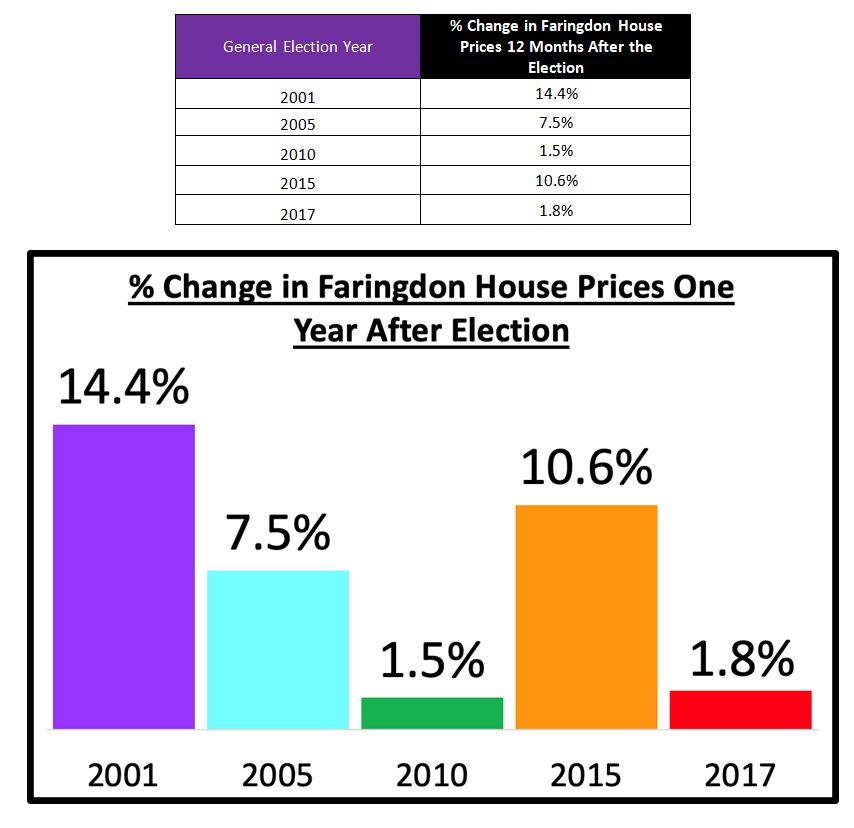
So, with past experience, a general election generally has a good effect rather than a worse effect on the Faringdon property market.
Looking at the rest of 2020, my intuition tells me in the better areas of Faringdon, it will likely be a seller’s market, as they will have more influence to ask for higher asking prices from Faringdon property buyers that have placed plans to move on hold for far too long – and this could push up Faringdon property values more promptly in the short term.
Yet, as more Faringdon properties come on to the market in the usual spring rush, we could see Faringdon home buyers having more choice and thus, as supply increases yet demand remains the same, buyers will get more power to negotiate a better deal. Irrespective of that, there is still the all-encompassing issue that I have spoken about many times in my blog of not enough homes being built to keep up with the number required, meaning negotiating power and prices being inflated.
The bottom line is, the Faringdon housing market will get a slight boost from the general election. The threat of a Jeremy Corbyn government obstructed some Faringdon landlords to build their buy to let portfolio in the later parts of 2019, so as long as sellers remain realistic with their pricing and present their properties in the best light, 2020 in the Faringdon property market should be a year of ‘steady as she goes’.
P.S .One final thought – remember what I said about the Halifax price Index being 5/6 months behind the times – don’t be alarmed when they announce in the March/April/May a reduction in property values – like I said before – this will be the prices achieved in the later parts of 2019 i.e. not what is happening right now.
Category: Sales
We have started the year enjoying the effects of a ‘Boris Bounce’. New buyers are flocking to the market, registering their interest and actively viewing available properties matching their requirements. New stock is coming to the market every day and it will not be long before the days start to lengthen and temperatures warm. So what steps can you take to make sure your home stands out above the competition and you attract the best buyers.
1. KERB APPEAL
Sixty seconds is all it can take for a potential buyer to decide they want to view your home or not. You want as many buyers as possible to cross your threshold, thus maximising your chance of securing the best buyer and the best price. Your front garden should be tidy and weed free. Trim back any overgrown vegetation and invest in fresh spring planters to place by your front door. Move cars and bins off the drive and leave plenty of space for your viewers to park. Finally make sure your front door shines – give it a good clean and touch up paintwork if necessary.
2. DECLUTTER
Pack up surplus furniture and personal items – hire a storage unit or put them in the loft. Clear shoes and coats from the porch, hall or cloakroom leaving these spaces feeling bigger. Bedrooms should be clear of yesterday’s clothes and shoes, books and papers, make up and jewellery. In bathrooms remove surplus make up, cosmetics, shower and bath products and change towels and bath mats for fresh, clean or brand new ones. Taps and surfaces should be cleaned and sparkling and the room well ventilated. Kitchen surfaces need to be as clear as possible creating maximum worktop space. Remove any pet bowls, sinks should sparkle and check for last night’s cooking smells! Tidy shelves.
3. SPRING CLEAN!
Your house needs to be scrupulously clean inside and out. Get out the duster and check all nooks and crannies. Don’t forget ceilings, light shades and dust all surfaces. Clean windows and mop floors. Keep your home tidy for those last minute viewings.
4. DIY
Buyers like a well kept and maintained home – they want to be able to just move in, unpack, and start enjoying their new home. Take a long hard look – have you finished all those DIY jobs you know need doing? Tackle them now and make sure all your light bulbs work, dripping taps are fixed and squeaky doors are oiled. Does the doorbell work and do all doors and windows close properly? Touch up paintwork and show your buyers your home has been well cared for.
5. Freshen Up
Visitors to your home should be greeted by the smell of fresh flowers or fresh air, not pets, smokers or last night’s cooking odours. Rehome your pets on viewing days, send smokers outside and keep all doors and windows open when cooking. Avoid fish and curry when you are trying to sell your home! Burning a scented candle helps to neutralise these odours or use a discreet air freshener.
6. Give your viewers space and privacy
On a dull day put turn on the lights and leave the heating on. If your viewers view your home when it is cold, they will always imagine it being cold.
Your buyers will be shown around your home by the agent and they need to be able to wander and get a feel for the place, to make comments out of your hearing and to discuss what works and what doesn’t work for them. The agent is trained to help overcome objections and to encourage an offer or second viewing. Go out if possible, if not, leave them alone. Your buyers will feel more relaxed and are more likely to make you an offer.
Finally, ask a friend or your agent to be brutally honest about what might need attention. Follow the advice and make sure your home is correctly priced. Before long, you will be on the move!
Category: Sales
Phillip Bishop, MD at Perry Bishop and Chambers, responds to the dramatic start to the new property year and looks at the green shoots of improvement.
Like early snowdrops, property buyers have begun poking their heads above ground after a long period of slumber. In fact, in some parts of the UK, there are significant and spectacular drifts of these ‘snowdrops’ appearing. Is this because of the time of year? Partly: but more likely because we are emerging from an extended and dark period of lifelessness in the property market.
Call it the Boris or Brexit Bounce if you like, but whatever term you give it there is a definite surge in the market with markedly more interest and activity. All over the country numbers of registrations, viewings, offers and sales are up on the previous two or three years – and it’s only February.
Confidence should be the name given to the first physical brick laid in any house construction or metaphorical brick laid in the re-building of the property market. It is confidence that is driving this newfound interest, and it comes at a perfect time of the year.
There was concern that a December election would be harmful in multiple ways. Well, in the case of the property market, it was perfect. With the will-we/won’t-we Brexit issue settled a large cloud of uncertainty was lifted and those who were sitting on their hands have, post-New Year, suddenly jumped into action.
Behind this energy is several years of pent up demand. Those who could wait to make a move or who were nervous did wait. But now the waiting is over. In all sectors of the market and across all regions demand is higher than it has been for years.
This is all exciting stuff, but we should not get too carried away. In property confidence can soon give way to over-confidence, with sellers often eager to set higher asking prices. We don’t want to see all those snowdrops droop under an ill-considered layer of expectation.
So prudence and guidance are critical factors in sustaining this excellent start to 2020. As always, before embarking on selling and or buying a property, we advise seeking the wisdom and counsel of a mature and experienced local independent estate agent before you join the fray. We’d love to help and advise you – do please call your local Perry Bishop and Chambers office.